
Jun 9, 2026 / Retrieval and data
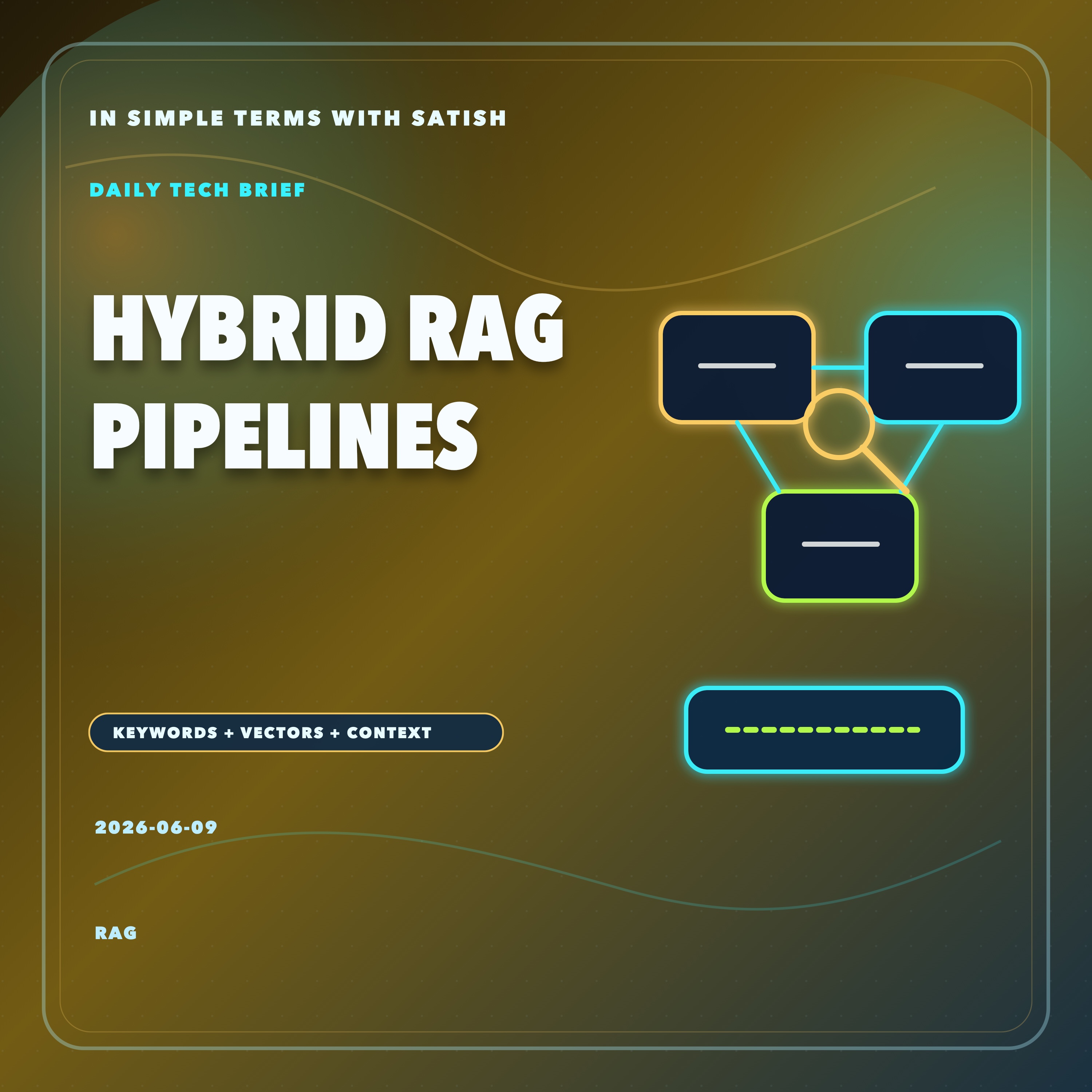
Hybrid RAG Pipelines
That is the pattern where an AI system looks up outside information before it answers.
Continue daily
Take the Daily Tech Brief with you
Get the daily lesson, Quick Check, saved learning habit, and notifications in the iOS or Android app.
Episode Notes
That is the pattern where an AI system looks up outside information before it answers.
In this episode, Satish uses a simple real-life example first, then turns the idea into a practical technical mental model for engineers and curious builders.
In Simple Terms with Satish: daily tech trends explained simply, with enough technical depth for builders.
Production note: This episode uses authorized synthetic narration based on Satish's own voice. The topic, script, and final editorial approval are by Satish.
Full episode transcript 570 words
Hello, and welcome to In Simple Terms with Satish. Today, we are talking about Hybrid RAG Pipelines. RAG stands for Retrieval Augmented Generation. That is the pattern where an AI system looks up outside information before it answers. And one useful thing to understand right now is that the best retrieval systems often do not rely on one search method alone. Let us start with an everyday example. Imagine you ask a great librarian a hard question. Part of the job is finding books that contain the exact words you used. That matters when the answer depends on a precise name, date, code, or phrase. But another part of the job is finding books that are about the same idea even if they use different wording. That matters when your question is expressed one way but the useful answer is written another way. And after the librarian pulls a short pile of books, there is still one more step. They put the most useful ones on top for your exact question. That is the basic idea behind a Hybrid RAG Pipeline. Now let us bring that back to technology. In modern AI retrieval systems, keyword search is good at exact matches. Vector search is good at semantic similarity. And re-ranking is good at taking a short list of candidates and deciding which ones are most relevant to the question being asked. A Hybrid RAG Pipeline combines those stages. Instead of asking one retrieval method to do everything, it lets each stage do what it is best at. Why does that matter? Because many RAG failures are retrieval failures before they are generation failures. The system may find related information but not the exact information. Or it may find the right evidence but rank it too low. Or it may send too many mediocre chunks to the model and expect the model to sort everything out on its own. That is one reason, bigger prompts do not automatically fix retrieval quality. If the evidence arrives in the wrong order, the answer can still drift. So what does the pipeline usually look like? First, the system stores chunks of text and their embeddings. Then, for a user question, it runs keyword retrieval and vector retrieval. After that, it merges the candidate results. Then, it re-ranks the short list to surface the strongest evidence. And only then does it send the final context into the model. That is the important architecture idea. One stage is about finding enough good candidates. Another stage is about ordering them well. And the final stage is about generating an answer from that grounded context. Now here is the catch. Some teams still treat RAG like one black box called search. That makes it hard to tell whether the problem came from keyword recall, semantic recall, re-ranking, or the final model response. So a better way to think is this. RAG is not just generation with extra files attached. It is a retrieval pipeline with several ranking decisions before the model starts writing. The takeaway is simple. The strongest AI retrieval systems often do not win because they found one perfect search method. They win because they combine exact match retrieval, semantic retrieval, and re-ranking into one cleaner path to evidence. If this helped you understand the topic in simple terms, follow or subscribe to In Simple Terms with Satish. I will see you in the next episode.
Continue learning
Related Daily Tech Brief episodes
Explore another explanation from Retrieval and data or continue through the latest technology systems.
Why Local-First Architecture Is Back
Local-first architecture is a way of building software where the user's device keeps a real working copy of useful data.
Vector Database Index Design
Vector database index design is the way a retrieval system organizes stored vectors so it can find similar results fast enough, cheaply enough, and accurately enough for the real workload.
Semantic Reranking
Semantic reranking is the step where an AI system takes a shortlist of search results and reorders them based on which result best matches the meaning of your question.