
Jun 11, 2026 / AI infrastructure
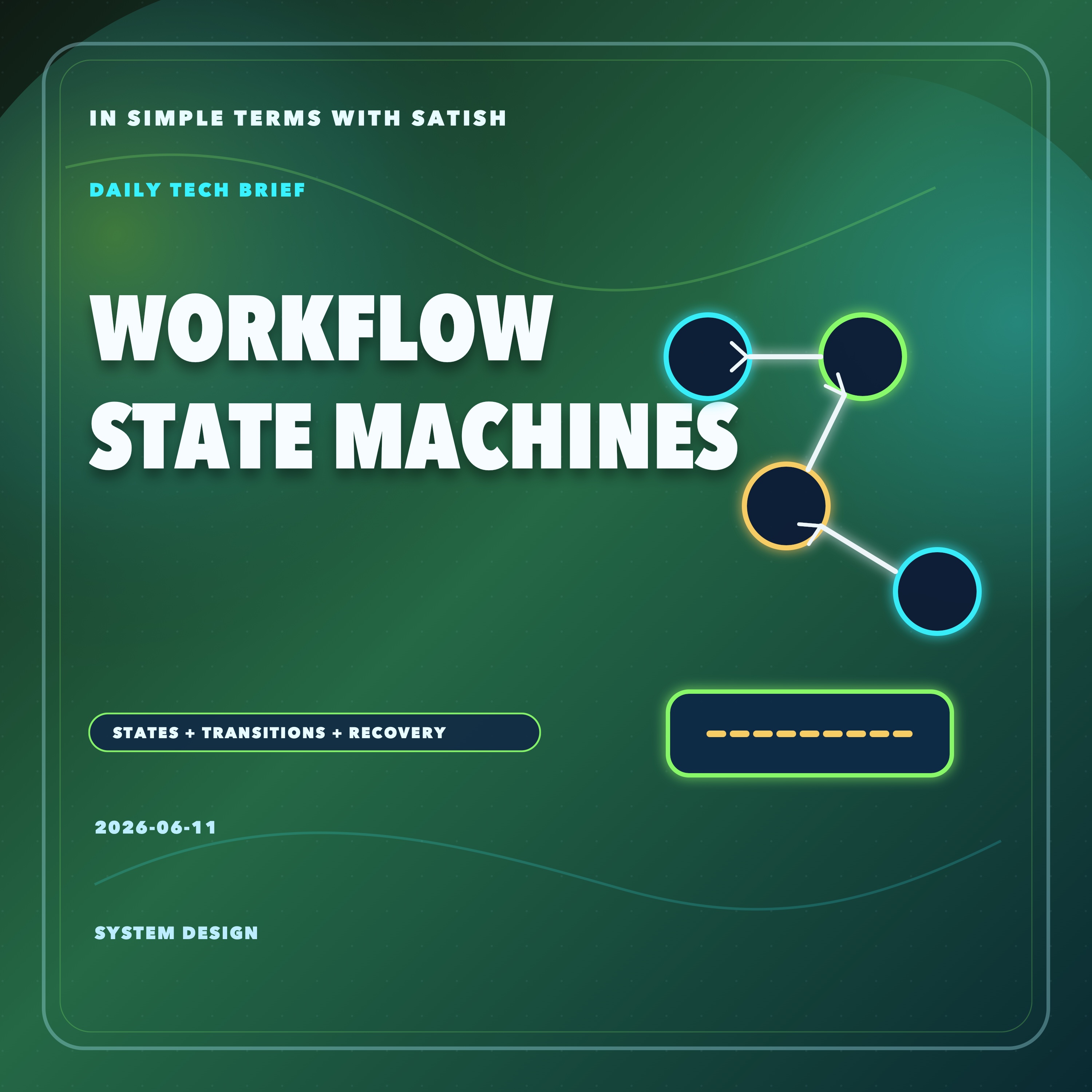
Workflow State Machines
A workflow state machine is the part of a system that keeps track of where a multi-step process is, what already happened, what should happen next, and what to do if something fails.
Continue daily
Take the Daily Tech Brief with you
Get the daily lesson, Quick Check, saved learning habit, and notifications in the iOS or Android app.
Episode Notes
A workflow state machine is the part of a system that keeps track of where a multi-step process is, what already happened, what should happen next, and what to do if something fails.
In this episode, Satish uses a simple real-life example first, then turns the idea into a practical technical mental model for engineers and curious builders.
In Simple Terms with Satish: daily tech trends explained simply, with enough technical depth for builders.
Production note: This episode uses authorized synthetic narration based on Satish's own voice. The topic, script, and final editorial approval are by Satish.
Full episode transcript 554 words
Hello, and welcome to In Simple Terms with Satish. Today we are talking about workflow state machines. Let us start with the technology first. A workflow state machine is the part of a system that keeps track of where a multi-step process is, what already happened, what should happen next, and what to do if something fails. Now let us use an everyday example. Imagine a package delivery driver with a full route for the day. There are successful deliveries, missed deliveries, addresses that need another attempt, and maybe one stop that needs a human decision. If the driver's app crashes in the middle of the day, you do not want the system to say, start over from the first package. You want it to know which stops already finished, which one failed, which one should retry later, and which one is waiting for help. That route sheet is the simple mental model for workflow state. Now back to the actual technical concept. As AI systems start using tools, they stop looking like one prompt and one answer. They start looking like a sequence of steps. Search for something, call an API, wait for a response, ask for approval, retry a failed tool call, resume later. That kind of system needs more than chat history. It needs run state. It needs to know which step it is on and what already completed. This matters because modern AI platforms are moving in exactly that direction. OpenAI now documents background mode for long-running tasks. That is a signal that AI work is no longer always expected to finish inside one live request. Other workflow systems like Temporal, Azure Durable Task, and AWS Step Functions all focus on the same core problem from different angles. How do you keep a long-running process reliable when failures, waits, and retries are normal? The answer is to make the workflow explicit. The system records progress, runs one step, stores the result, and then decides the next step from known state. If something fails, it does not need to forget everything. It can retry the failed part or resume from the last good checkpoint. This is where workflow state machines become important for AI agents. Without them, a tool-using agent is more likely to lose its place. It may repeat work, it may retry too much, it may forget an approval step, it may even repeat a side effect that should only happen once. There is also an important limitation here. Rollback does not always mean the outside world goes backward automatically. If a system already sent an email, created a ticket, or charged a card, that action already happened. So recovery often means compensation or a different follow-up step, not magic rewind. That is the catch. Workflow state makes recovery much better, but it does not erase real-world side effects. The takeaway is simple. As AI systems become long-running and tool-using, reliability depends less on pretending everything is one giant loop and more on keeping explicit state for what already happened, what should retry, and what can safely resume. Workflow state machines are one of the quiet technologies making serious AI agents possible. If this helped you understand the topic in simple terms, follow or subscribe to In Simple Terms with Satish. I will see you in the next episode.
Continue learning
Related Daily Tech Brief episodes
Explore another explanation from AI infrastructure or continue through the latest technology systems.

How The Internet Travels Under The Ocean
When you send a WhatsApp overseas, join a video call with a team in another country, upload a photo to the cloud, or open a website hosted far away, your data may be crossing an ocean.

Vibe Coding: Why Everyone Is Talking To Their Code Editor
Today we are talking about vibe coding, the idea that you can build software by talking to an AI coding tool instead of typing every line yourself.
The Real Cost Of Asking AI One Question
Today we are talking about large language model inference, and the real cost of asking AI one question.