
Jun 12, 2026 / AI infrastructure
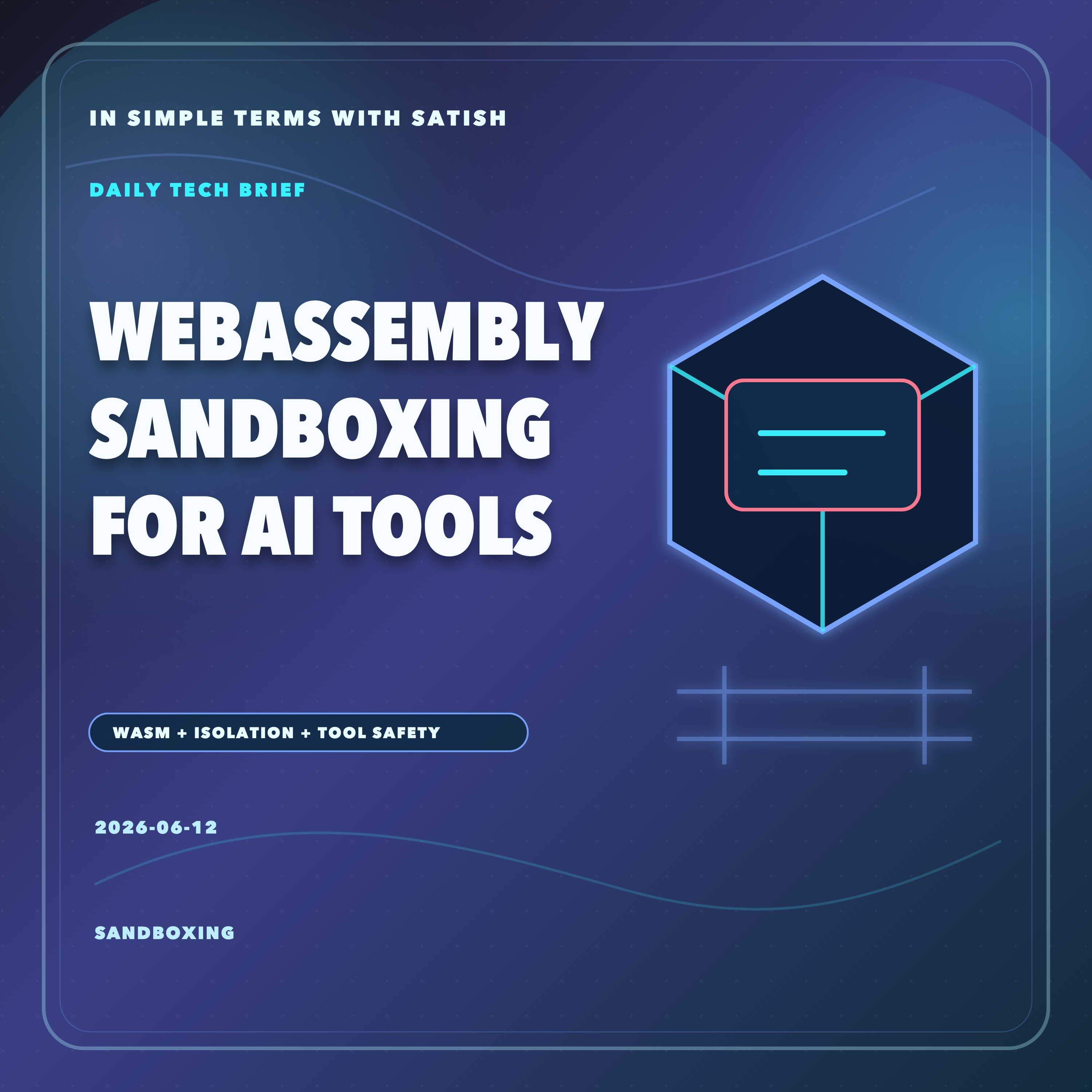
WebAssembly Sandboxing For AI Tools
WebAssembly sandboxing is a way to run code inside a controlled environment where the code only gets the specific access that the host system decides to give it.
Continue daily
Take the Daily Tech Brief with you
Get the daily lesson, Quick Check, saved learning habit, and notifications in the iOS or Android app.
Episode Notes
WebAssembly sandboxing is a way to run code inside a controlled environment where the code only gets the specific access that the host system decides to give it.
In this episode, Satish uses a simple real-life example first, then turns the idea into a practical technical mental model for engineers and curious builders.
In Simple Terms with Satish: daily tech trends explained simply, with enough technical depth for builders.
Production note: This episode uses authorized synthetic narration based on Satish's own voice. The topic, script, and final editorial approval are by Satish.
Full episode transcript 597 words
Hello, and welcome to In Simple Terms with Satish.
Today we are talking about WebAssembly sandboxing for AI tools.
Let us start with the technology first.
WebAssembly sandboxing is a way to run code inside a controlled environment where the code only gets the specific access that the host system decides to give it.
Now let us use an everyday example.
Imagine you hire someone to fix one cabinet in your kitchen.
You would not normally give that person every key to your house, access to every room, and permission to open every drawer.
You would give access to the front door, the kitchen, and the tools needed for that one job.
That is the basic idea here.
Now back to the actual technical concept.
AI systems are using more and more tools.
Those tools might search files, transform data, call APIs, or run custom code written by different people in different languages.
The problem is that once you let code run on a machine, you have to decide what that code is allowed to touch.
Can it read any file?
Can it open any network connection?
Can it call anything on the host?
WebAssembly is interesting because it starts with a narrower contract.
The code runs inside a sandbox.
It does not automatically get raw system access.
Instead, the host has to expose specific interfaces.
That means the runtime can be much more selective.
This is where WASI becomes important.
WASI is a standard way for WebAssembly programs to interact with things outside the sandbox, such as files and other host features.
The important idea is capability-based access.
In simple terms, that means the code only gets the exact keys it was handed.
If a tool only needs one directory, it should only get that directory.
If it does not need network access, it should not get network access.
If it only needs one small interface from the host, that should be the only interface it sees.
That matters for AI tools because tool safety is not only about choosing the right tool.
It is also about what happens after the tool starts running.
Even if the model makes a reasonable choice, the runtime still needs a good boundary around that tool.
There is also a second important idea here.
WebAssembly is not only about sandboxing one piece of code.
It is also becoming a way to package reusable components that can work across languages and platforms.
That makes it useful for plugin systems, portable extensions, and tool ecosystems where you do not want every integration to become a custom native install.
Now here is the catch.
Sandboxing the runtime does not automatically make the tool output trustworthy.
A tool can stay inside its memory and file limits and still return bad, misleading, or risky output.
So runtime containment and output trust are two different problems.
Another catch is resource limits.
A tool can still waste CPU time or memory even if it cannot escape the sandbox.
So a real system needs capability limits and resource limits together.
The takeaway is simple.
As AI systems use more tools, plugins, and custom execution, they need a runtime model that grants only the specific access a tool needs instead of full machine trust.
That is why WebAssembly sandboxing is becoming more important.
It gives builders a cleaner way to ask a very practical question:
what exact capabilities should this tool have?
If this helped you understand the topic in simple terms, follow or subscribe to In Simple Terms with Satish. I will see you in the next episode.
Quick Check
-
What is the core idea behind WebAssembly Sandboxing For AI Tools?
WebAssembly sandboxing is a way to run code inside a controlled environment where the code only gets the specific access that the host system decides to give it.
-
Why does WebAssembly Sandboxing For AI Tools matter?
The problem is that once you let code run on a machine, you have to decide what that code is allowed to touch.
-
Which plain-English example helped explain the topic?
Imagine you hire someone to fix one cabinet in your kitchen. You would not normally give that person every key to your house, access to every room, and permission to open every...
-
Which term is most connected to this lesson?
Key terms for this lesson include WebAssembly, Sandboxing, Tools, infrastructure.
-
What is the practical takeaway?
As AI systems use more tools, plugins, and custom execution, they need a runtime model that grants only the specific access a tool needs instead of full machine trust.
Continue learning
Related Daily Tech Brief episodes
Explore another explanation from AI infrastructure or continue through the latest technology systems.

How The Internet Travels Under The Ocean
When you send a WhatsApp overseas, join a video call with a team in another country, upload a photo to the cloud, or open a website hosted far away, your data may be crossing an ocean.
Vibe Coding: Why Everyone Is Talking To Their Code Editor
Today we are talking about vibe coding, the idea that you can build software by talking to an AI coding tool instead of typing every line yourself.
The Real Cost Of Asking AI One Question
Today we are talking about large language model inference, and the real cost of asking AI one question.