
Jun 17, 2026 / Retrieval and data
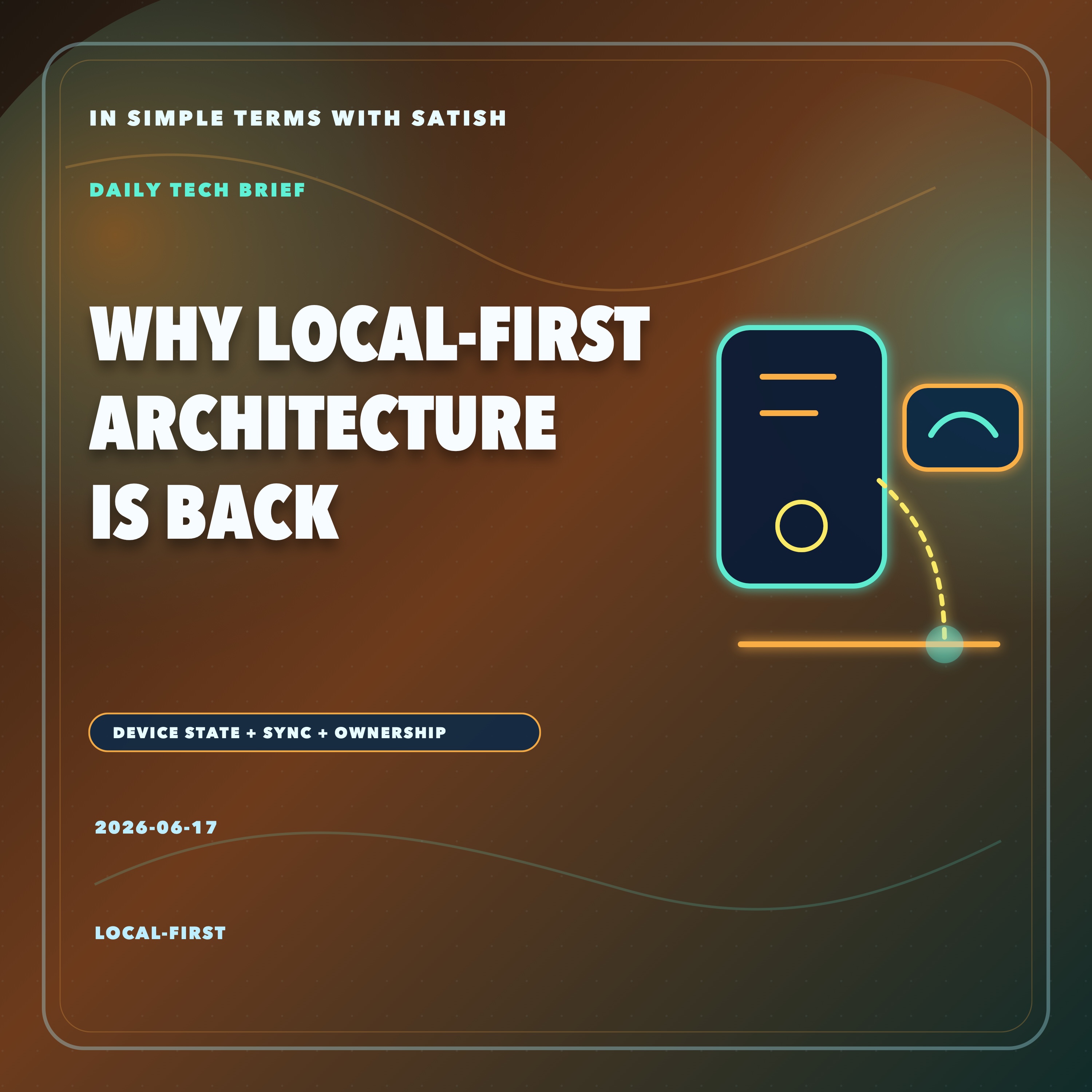
Why Local-First Architecture Is Back
Local-first architecture is a way of building software where the user's device keeps a real working copy of useful data.
Continue daily
Take the Daily Tech Brief with you
Get the daily lesson, Quick Check, saved learning habit, and notifications in the iOS or Android app.
Episode Notes
Local-first architecture is a way of building software where the user's device keeps a real working copy of useful data.
In this episode, Satish uses a simple real-life example first, then turns the idea into a practical technical mental model for engineers and curious builders.
In Simple Terms with Satish: daily tech trends explained simply, with enough technical depth for builders.
Production note: This episode uses authorized synthetic narration based on Satish's own voice. The topic, script, and final editorial approval are by Satish.
Full episode transcript 731 words
Hello, and welcome to In Simple Terms with Satish.
Today we are talking about local-first architecture, and why it is back.
Let us start with the technology first.
Local-first architecture is a way of building software where the user's device keeps a real working copy of useful data.
The app can read locally.
The app can often record changes locally.
Then it syncs with servers and other devices in the background.
So the app does not become useless the moment the network becomes slow, weak, or unavailable.
Now let us understand this with a simple everyday example.
Imagine a team planning a trip.
In the old model, there is one whiteboard in the office.
If you are in the office, you can read the plan and update it.
If you are traveling and cannot reach the office, you are stuck.
You might remember a few details, but the real plan lives somewhere else.
Local-first is more like every teammate having a real notebook.
Each person can read the plan, add notes, and keep working even while away from the office.
Later, when everyone reconnects, the notebooks are compared and merged into the shared plan.
The office still matters.
It can decide who is allowed on the trip, which version is official, and where the backup lives.
But useful work no longer depends on standing in front of the one whiteboard.
That is the core idea.
Now back to the actual technical concept.
For a long time, many web apps were server-first.
The server had the real data.
The client asked for it.
The client displayed it.
When the user changed something, the client sent the change back and waited.
That can be correct, but it often feels fragile.
A weak connection makes the app slow.
A lost connection can stop the workflow.
And optimistic user interfaces can become confusing when the server later rejects a change.
Local-first changes the data path.
The client has a durable local store.
That might be an embedded database, a local document store, or browser-backed storage.
The interface reads from that local store first.
When the user makes a change, the app can record the intent locally first.
Then a sync layer moves the right data between the device and the server.
The phrase "right data" matters.
A serious local-first app should not blindly copy everything.
It should sync the subset the user needs and is allowed to have.
That subset might be one workspace, one project, one document, or one query-shaped slice of data.
This is why local-first is not just caching.
A cache is usually a temporary copy of server data.
Local-first state is part of the working system.
It has to survive app restarts.
It has to handle reconnects.
It has to understand pending changes.
It has to recover when local storage is cleared.
And it has to deal with conflicts.
Conflict resolution is the catch.
If two people edit the same thing while offline, what happens when they reconnect?
Sometimes the app can merge changes automatically.
Sometimes the server should reject one change.
Sometimes the user needs to decide.
But the app needs a real rule.
Another catch is authorization.
If data is synced onto a device, that device can now hold it locally.
So permissions must be part of the sync design, not only part of the normal API.
The permission check has to happen before the wrong data lands locally.
For engineers, the practical pattern is this:
Design four things together.
First, the local store.
Second, the sync engine.
Third, the server authority boundary.
Fourth, the conflict policy.
If those four pieces are clear, local-first can make software feel fast, reliable, and respectful of the user's work.
If they are vague, offline mode becomes a source of data bugs.
The clear takeaway is this:
Local-first does not mean no backend.
It means the client becomes a real stateful node in the system.
The server still matters, but it is no longer the only place where software can work.
In simple terms, the old app waits for the whiteboard.
The local-first app lets you keep writing in the notebook, then syncs the plan when the connection returns.
That is why this architecture is back.
If this helped you understand the topic in simple terms, follow or subscribe to In Simple Terms with Satish. I will see you in the next episode.
Quick Check
-
What is the core idea behind Why Local-First Architecture Is Back?
Local-first architecture is a way of building software where the user's device keeps a real working copy of useful data.
-
Why does Why Local-First Architecture Is Back matter?
Local-first architecture is a way of building software where the user's device keeps a real working copy of useful data.
-
Which plain-English example helped explain the topic?
Imagine a team planning a trip. In the old model, there is one whiteboard in the office.
-
Which term is most connected to this lesson?
Key terms for this lesson include Why, Local-First, Architecture, Back, Retrieval, and.
-
What is the practical takeaway?
The clear takeaway is this: Local-first does not mean no backend. It means the client becomes a real stateful node in the system.
Continue learning
Related Daily Tech Brief episodes
Explore another explanation from Retrieval and data or continue through the latest technology systems.
Vector Database Index Design
Vector database index design is the way a retrieval system organizes stored vectors so it can find similar results fast enough, cheaply enough, and accurately enough for the real workload.
Semantic Reranking
Semantic reranking is the step where an AI system takes a shortlist of search results and reorders them based on which result best matches the meaning of your question.
Hybrid RAG Pipelines
That is the pattern where an AI system looks up outside information before it answers.