
Jun 19, 2026 / Observability
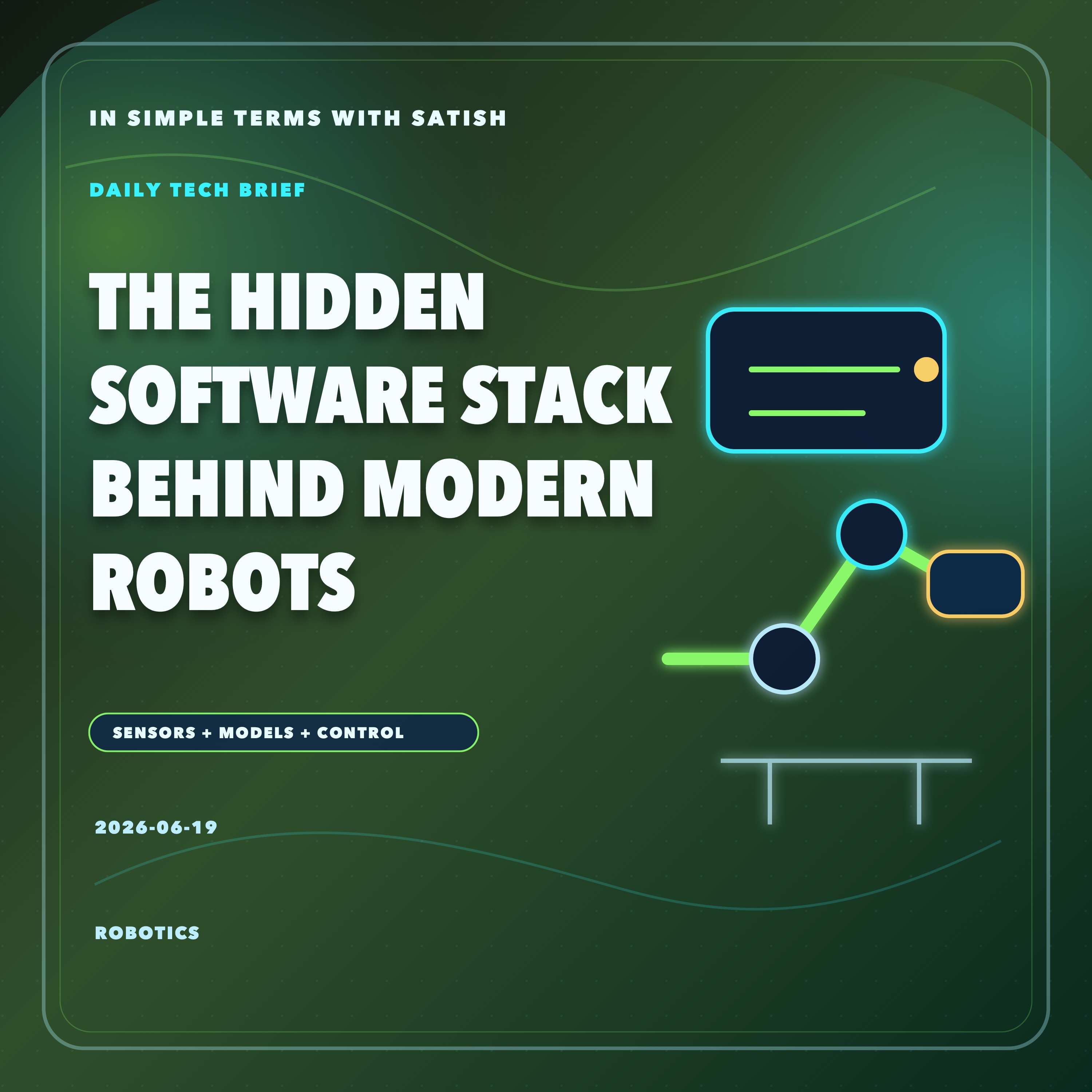
The Hidden Software Stack Behind Modern Robots
A modern robot is not just a metal body with an AI brain. It is a real-time software system that has to sense the world, understand what is happening, decide what should happen next, and move safely.
Continue daily
Take the Daily Tech Brief with you
Get the daily lesson, Quick Check, saved learning habit, and notifications in the iOS or Android app.
Episode Notes
A modern robot is not just a metal body with an AI brain. It is a real-time software system that has to sense the world, understand what is happening, decide what should happen next, and move safely.
In this episode, Satish uses a simple real-life example first, then turns the idea into a practical technical mental model for engineers and curious builders.
In Simple Terms with Satish: daily tech trends explained simply, with enough technical depth for builders.
Production note: This episode uses authorized synthetic narration based on Satish's own voice. The topic, script, and final editorial approval are by Satish.
Satish Take
The clear takeaway is this: Modern robots are not only AI with a body. They are real-time software stacks where sensors, models, middleware, controllers, safety gates, observability, and recovery work together.
Full episode transcript 750 words
Hello, and welcome to In Simple Terms with Satish.
Today we are talking about the software stack behind modern robots.
Let us start with the technology first.
A modern robot is not just a metal body with an AI brain. It is a real-time software system that has to sense the world, understand what is happening, decide what should happen next, and move safely.
That last part matters because robot output is physical.
If a normal app is wrong, the screen may show bad information. If a robot is wrong, it can drop an object, hit a shelf, lose balance, or surprise a person.
So the robot needs much more than intelligence. It needs a stack.
Imagine a busy restaurant kitchen.
A customer says, "Please bring the soup to table five."
That sentence sounds easy. But someone has to hear the request, find the soup, know where table five is, carry the bowl without spilling it, avoid people, and recover if the path is blocked.
The request is simple. The execution stack is not.
A robot is similar.
If you tell a robot, "Unload the dishwasher," it has to see the dishes, understand the task, estimate its body position, choose the next item, grasp fragile objects, avoid collisions, recover from slips, and stop safely if a person gets too close.
Now return to the actual stack.
The first layer is sensors. A robot may use cameras, depth sensors, touch sensors, force sensors, joint sensors, and position signals.
The second layer is perception and state estimation. This turns raw signals into useful meaning: where the cup is, where the arm is, whether an object is slipping, and whether a person is nearby.
The third layer is reasoning, planning, or a learned policy. This is where modern AI gets attention. A model may connect what the robot sees, what a human asks, and what action could help.
But the model is not the whole robot.
A model can suggest an action. The rest of the stack has to decide whether that action is safe, timely, and allowed.
The fourth layer is middleware. Middleware is the nervous system that moves information between the robot's parts: perception, planning, control, safety, and logs.
That sounds like plumbing, but it is becoming governance. Once AI models are part of the control path, the system needs to know who had authority and what fallback should take over.
The fifth layer is control and safety. This is where intent becomes motor commands. The robot has to care about speed, force, balance, collision limits, emergency stops, and human proximity.
Physics is always in the loop.
The sixth layer is simulation and data. Robots need rehearsal. Simulation helps teams train policies, generate synthetic data, test edge cases, and replay failures before hardware gets damaged.
But simulation is not magic. Real homes, factories, farms, and warehouses have clutter, lighting changes, worn parts, moving people, and unexpected objects.
The seventh layer is observability and recovery. When a robot fails, engineers need more than a video clip. They need to know what the robot saw, what the model inferred, which command was sent, and why recovery triggered.
Here is the simple loop.
Observe.
Interpret.
Decide.
Bound.
Act.
Monitor.
Recover.
Learn.
The most important word is "bound."
A model output should not become physical action just because the model produced it. It should pass through timing, safety, authority, and recovery checks.
The catch is that public robot demos often hide this stack. You see the successful clip. You do not always see the resets, teleoperation, failed grasps, lighting limits, safety boundaries, or recovery behavior.
So when you see a robot demo, ask better engineering questions.
Was it autonomous? Were there resets? What happens if the object moves? What logs explain the failure? What controller takes over?
That is how you separate a robot video from a robot system.
The clear takeaway is this:
Modern robots are not only AI with a body. They are real-time software stacks where sensors, models, middleware, controllers, safety gates, observability, and recovery work together.
For students and engineers, robotics is worth studying because it connects AI, distributed systems, embedded systems, safety, simulation, and physical design in one problem.
In simple terms, a useful robot is not just smart. It is bounded, observable, recoverable, and safe enough to act in the real world.
If this helped you understand the topic in simple terms, follow or subscribe to In Simple Terms with Satish. I will see you in the next episode.
Quick Check
-
What is the core idea behind The Hidden Software Stack Behind Modern Robots?
A modern robot is not just a metal body with an AI brain.
-
Why does The Hidden Software Stack Behind Modern Robots matter?
This turns raw signals into useful meaning: where the cup is, where the arm is, whether an object is slipping, and whether a person is nearby.
-
Which plain-English example helped explain the topic?
Imagine a busy restaurant kitchen. A customer says, "Please bring the soup to table five." That sentence sounds easy.
-
Which term is most connected to this lesson?
Key terms for this lesson include The, Hidden, Software, Stack, Modern, Robots.
-
What is the practical takeaway?
The clear takeaway is this: Modern robots are not only AI with a body. They are real-time software stacks where sensors, models, middleware, controllers, safety gates,...
Continue learning
Related Daily Tech Brief episodes
Explore another explanation from Observability or continue through the latest technology systems.
How FIFA's Smart Ball and VAR Actually Work
Today we are talking about FIFA's smart ball and VAR, and how technology helps referees make close decisions at the World Cup.
Why Space Is Becoming Infrastructure
Today we are talking about space infrastructure, and why SpaceX is only one visible signal of a much bigger technology shift.
OpenTelemetry for AI Agent Traces
This matters because AI agents are starting to behave less like simple chatbots, and more like small distributed systems.