
Jun 21, 2026 / AI infrastructure
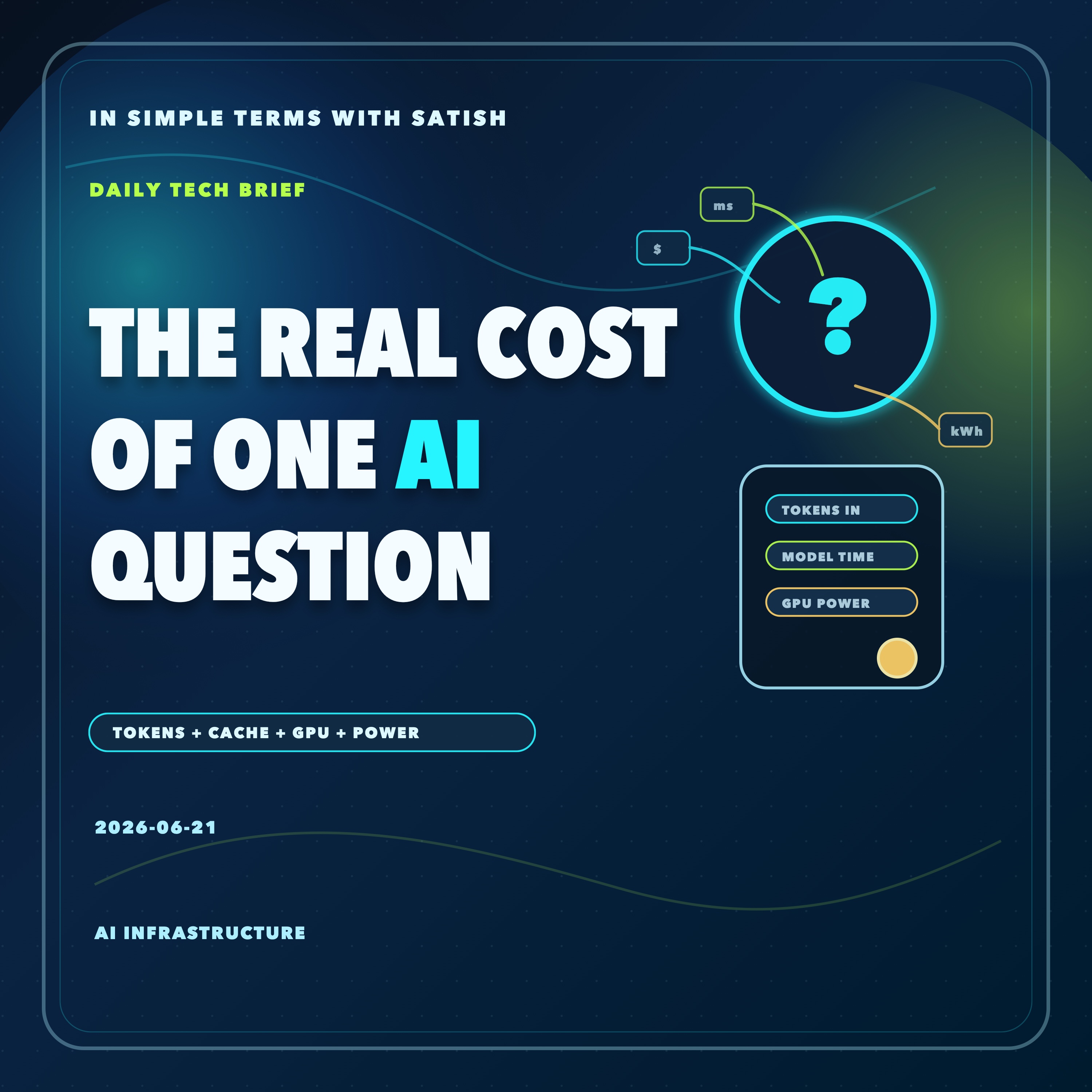
The Real Cost Of Asking AI One Question
Today we are talking about large language model inference, and the real cost of asking AI one question.
Continue daily
Take the Daily Tech Brief with you
Get the daily lesson, Quick Check, saved learning habit, and notifications in the iOS or Android app.
Episode Notes
Today we are talking about large language model inference, and the real cost of asking AI one question.
In this episode, Satish uses a simple real-life example first, then turns the idea into a practical technical mental model for engineers and curious builders.
In Simple Terms with Satish: daily tech trends explained simply, with enough technical depth for builders.
Production note: This episode uses authorized synthetic narration based on Satish's own voice. The topic, script, and final editorial approval are by Satish.
Satish Take
The clear takeaway is this: The real cost of asking AI one question is the hidden serving stack behind the answer. Tokens go in, the prompt is processed, memory is used, the answer is generated piece by piece, caches may help, models may be routed, and...
Full episode transcript 745 words
Hello, and welcome to In Simple Terms with Satish.
Today we are talking about large language model inference, and the real cost of asking AI one question.
Let us start with the technology first.
When you type a question into an AI chatbot, it feels like a normal search box. You ask, and it answers.
Behind that simple box is a serving system. It turns your words into tokens, processes the prompt, keeps temporary memory, generates the answer piece by piece, schedules expensive hardware, and returns the result quickly enough that it feels natural.
Let us understand this with a simple everyday example.
Imagine a help desk inside a large library.
If you ask, "What time does the library close?", one person can answer quickly.
If you bring a thick folder and ask, "Read this and summarize the risks," the staff first has to read the folder.
If you ask for a one-line answer, the work is small. If you ask for a ten-page report, the staff keeps writing for longer. If many people ask the same question, the help desk can reuse a prepared answer. And simple questions should go to the front desk, not the most senior researcher in the building.
The first cost is input.
The model does not read text exactly like we do. It breaks text into tokens. Your question, conversation history, system instructions, tool descriptions, retrieved documents, and files can all become input tokens. So a short-looking question may carry a large hidden context.
The second cost is prompt processing.
Before the model answers, it has to process the prompt. Engineers often call this the prefill stage. Long prompts create more work before the first answer token appears.
The third cost is output.
The answer is generated token by token. A short answer and a long essay are not the same workload. The long answer keeps the model running step after step.
Now add memory.
To avoid recomputing everything, model-serving systems keep temporary attention state while generating. Engineers often call this the key-value cache. It helps the model generate faster, but it uses accelerator memory. With long prompts or many users, memory becomes a real bottleneck.
Then comes batching.
AI hardware is expensive, so serving systems try to keep it busy. If requests can be grouped together, the system may produce more useful work. But batching creates tradeoffs: some users may wait longer, and the system has to balance throughput with responsiveness.
Then comes caching. Many AI apps repeat the same instructions every time: style rules, safety rules, tool descriptions, or output formats. If the beginning of the prompt repeats, the system may reuse work instead of processing it from scratch.
Then comes model routing.
Not every question needs the largest model. A simple definition can go to a smaller model. A hard reasoning question, code review, or high-risk analysis may need a stronger model. Good AI systems route work based on difficulty, quality, latency, and cost.
Finally, there is the physical layer.
The answer comes from a data center with servers, accelerators, networking, power systems, cooling, and backup infrastructure. The International Energy Agency projects data-center electricity demand to more than double by 2030, with AI as a major driver.
Here is the catch: be careful with anyone who claims every AI question uses one exact amount of water, electricity, or carbon. That number is not universal. It depends on the model, prompt length, answer length, hardware, utilization, cooling, location, electricity mix, caching, batching, and tool calls.
So the useful engineering lesson is a checklist: how many input tokens went in, how many output tokens came out, whether part of the prompt was cached, whether the task needed a large model, whether tools were called, and whether the answer was longer than needed.
The clear takeaway is this:
The real cost of asking AI one question is the hidden serving stack behind the answer. Tokens go in, the prompt is processed, memory is used, the answer is generated piece by piece, caches may help, models may be routed, and data-center power keeps the system running.
In simple terms, the AI text box looks small because the interface is simple.
But behind one answer is a full system of compute, memory, software, and electricity trying to make intelligence feel instant, useful, and affordable.
If this helped you understand the topic in simple terms, follow or subscribe to In Simple Terms with Satish. I will see you in the next episode.
Quick Check
-
What is the core idea behind The Real Cost Of Asking AI One Question?
Here is the catch: be careful with anyone who claims every AI question uses one exact amount of water, electricity, or carbon.
-
Why does The Real Cost Of Asking AI One Question matter?
If requests can be grouped together, the system may produce more useful work.
-
Which plain-English example helped explain the topic?
Imagine a help desk inside a large library. If you ask, "What time does the library close?", one person can answer quickly.
-
Which term is most connected to this lesson?
Key terms for this lesson include The, Real, Cost, Asking, One, Question.
-
What is the practical takeaway?
The clear takeaway is this: The real cost of asking AI one question is the hidden serving stack behind the answer. Tokens go in, the prompt is processed, memory is used, the...
Continue learning
Related Daily Tech Brief episodes
Explore another explanation from AI infrastructure or continue through the latest technology systems.

How The Internet Travels Under The Ocean
When you send a WhatsApp overseas, join a video call with a team in another country, upload a photo to the cloud, or open a website hosted far away, your data may be crossing an ocean.
Vibe Coding: Why Everyone Is Talking To Their Code Editor
Today we are talking about vibe coding, the idea that you can build software by talking to an AI coding tool instead of typing every line yourself.
JSON Schema Structured Outputs
Structured outputs are the pattern where an AI model returns data that is shaped to match a schema your software defines in advance.