
Aug 24, 2026 / AI workflow architecture
AI vs Automation: Should You Use AI for Everything?
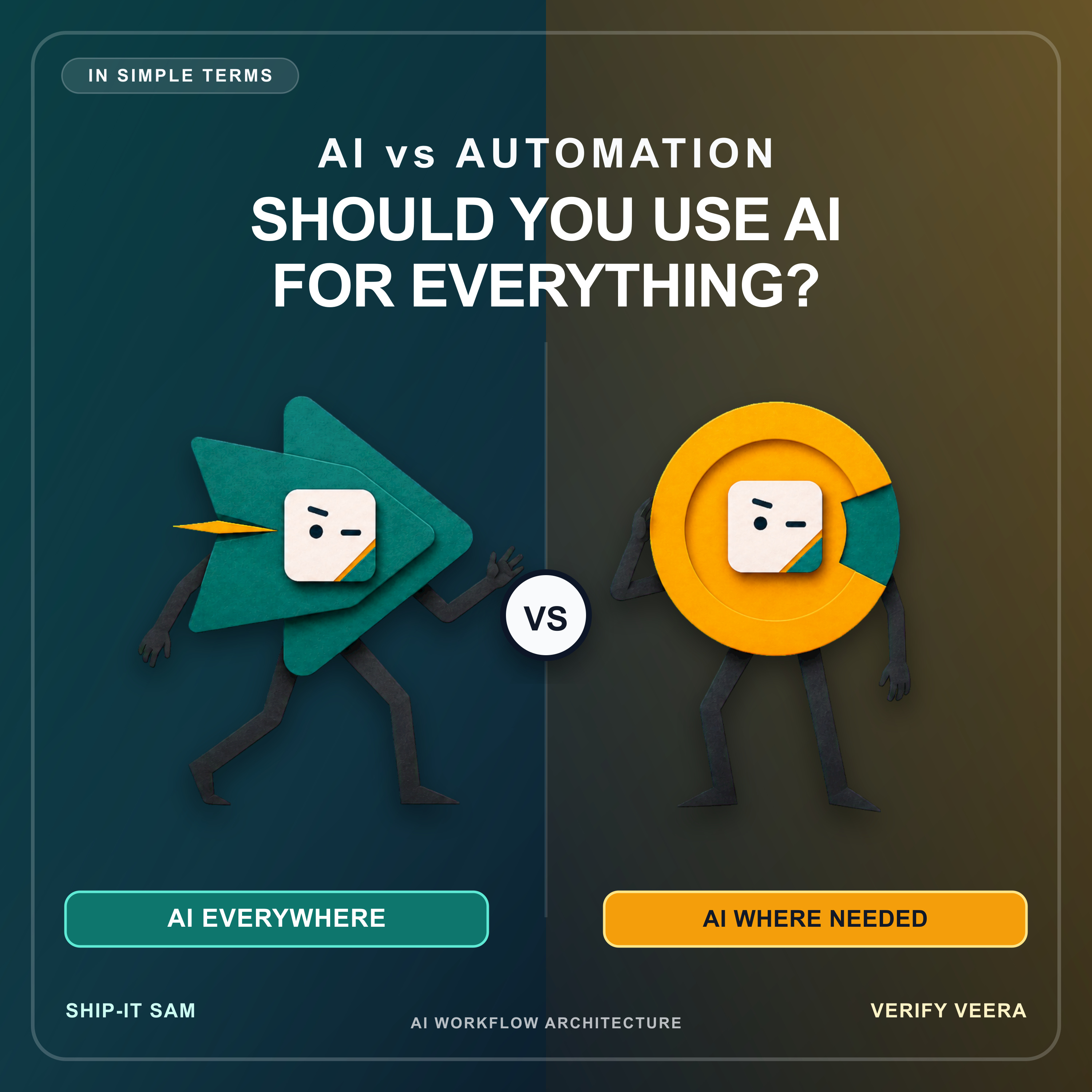
Ship-It Sam draws one large AI box around an entire product-launch workflow. Verify Veera divides the same workflow into smaller decisions. Their conversation—and two unexpected changes—reveal the difference between asking whether AI can perform a task and asking whether the task actually needs AI.
Continue daily
Take the Daily Tech Brief with you
Get the daily lesson, Quick Check, saved learning habit, and notifications in the iOS or Android app.
Episode Notes
Ship-It Sam draws one large AI box around an entire product-launch workflow. Verify Veera divides the same workflow into smaller decisions. Their conversation—and two unexpected changes—reveal the difference between asking whether AI can perform a task and asking whether the task actually needs AI.
Follow In Simple Terms with Satish for one clear technology explanation every day. Open once a day. Learn one concept. Leave smarter.
Disclosure: This episode uses authorized synthetic narration based on Satish's own voice. The topic, script, and final editorial approval are by Satish.
Satish Take
The practical question is not whether AI can do a task. It is whether the task needs interpretation, prediction, or generation. Clear rules and defined outputs often belong in deterministic automation, with AI used where ambiguity creates value.
Full episode transcript 712 words
Hello, and welcome to In Simple Terms with Satish.
Ship-It Sam and Verify Veera are standing before two whiteboards.
They must prepare one thousand products for an online launch.
Sam has drawn one enormous box. Inside it, he has written: “AI agent.” Supplier documents enter the box. Prices, inventory settings, descriptions, and publication schedules come out.
Veera studies the diagram.
“Your AI is doing everything?”
“That is the idea.”
“Reading supplier documents?”
“Yes.”
“Creating descriptions, calculating prices, generating SKUs, and scheduling publication?”
“Yes.”
Veera pauses. “Is there anything it isn't doing?”
Sam smiles. “Taking credit for my architecture.”
Veera draws several smaller boxes.
Sam looks concerned. “That appears to be considerably more work.”
“Initially,” Veera says.
Sam points to his design. “My agent receives one objective, understands the context, and coordinates the workflow. If something changes, I update the instructions. Why build five automations?”
“That is a reasonable argument,” Veera replies. “I know AI can perform these steps. I am asking whether every step needs AI.”
Before Sam can answer, a supplier message arrives. The approved spreadsheet is gone. In its place are two photographs and one sentence:
“New bottle. Same as last year, but smaller and better for cold drinks.”
Veera's structured import cannot read it. Sam gives it to his AI agent.
The agent examines the photographs, finds last year's product, interprets the message, creates a structured record, and drafts a customer-friendly description.
Sam turns to Veera. “Still think the large AI box is unnecessary?”
“For this step, you were right. The information was unstructured, and the output required interpretation and creation.”
Sam pretends to photograph the moment.
Then the finance team sends another message. The margin for drinkware has changed from fifteen percent to twelve percent.
Sam updates his agent: “Find every drinkware product and recalculate its price.” The AI can perform the task.
Veera changes one value in her pricing rule. Her system identifies the affected products, recalculates their prices, and records the exact rule used.
Veera looks at Sam. “Still want AI calculating every known formula?”
Sam slowly lowers his imaginary camera. “For this step, you were right. The company has already decided the answer.”
“Exactly. Capability is not the same as suitability.”
Sam does not surrender. “Traditional automation also costs money. Someone must build the rules, maintain integrations, and update them when the process changes.”
“Correct,” Veera says. “AI is not automatically expensive, and automation is not automatically cheap. We compare the complete systems.”
She writes four questions:
How quickly can we build it?
How consistently does it operate?
What does it cost at scale?
How easily can we explain and change it?
“My approach gives us speed and adaptability,” Sam says.
“Especially while we are discovering the workflow,” Veera replies.
“And yours gives us repeatability when the process becomes stable.”
They return to the whiteboards.
Sam makes his AI box smaller—but more important.
AI reads inconsistent documents, interprets unclear information, and creates customer-friendly content.
Automation validates required fields, generates SKUs, applies pricing formulas, manages inventory, and schedules publication.
Before AI changes a price or publishes a product, deterministic validation checks its structured output.
Sam studies the design. “So AI provides interpretation and creativity.”
“And automation provides repeatability and control.”
“Which one won?”
Veera points to the connected boxes. “The system.”
Their conversation gives us a practical method.
Break a workflow into individual steps. If a rule and required output are already defined, begin with automation. If a step requires ambiguity, unstructured information, prediction, or generation, consider AI. Before a consequential action, add proportionate validation or human approval. Then measure quality, time, model calls, operating cost, and human intervention across the complete workflow.
Successful AI adoption is not measured by how many steps contain AI. It is measured by whether AI makes the complete system better.
Sam asked, “Can AI perform this task?” Veera asked, “Does this task need AI?” The strongest team asks both.
Think of one workflow in your workplace. Which step belongs to AI, and which should remain ordinary automation? Share your example in the comments.
If this helped you understand the topic in simple terms, follow or subscribe to In Simple Terms with Satish, and share this episode with one friend who likes technology. I will see you in the next episode.
Quick Check
-
What question does Verify Veera ask before adding AI?
The episode contrasts capability with necessity: AI is useful when the step benefits from interpretation or generation.
-
Which task type is usually a good fit for deterministic automation?
When the rule and output are known, deterministic automation is easier to test, audit, and change.
-
Where can AI add value in a workflow?
AI fits steps where fixed rules are insufficient and interpretation or generation is valuable.
-
What should happen before consequential automated actions?
For consequential actions, AI output should be constrained by validation, review, policy, or deterministic checks.
-
What should teams measure in AI-assisted workflows?
Good workflow architecture measures the actual outcome, cost, quality, and intervention rate.
Continue learning
Related Daily Tech Brief episodes
Explore another explanation from AI workflow architecture or continue through the latest technology systems.
What Is Multi-head Latent Attention—and How Does It Shrink AI's Memory?
Why does a long AI conversation consume more accelerator memory with every token? Follow the growth of the key-value cache, then see how Multi-head Latent Attention stores a compact latent representation, preserves position through decoupled RoPE, and trades a larger cache for additional projection work and specialized kernels.

What Is a Mixture of Experts Model—and Why Does Only Part of It Run?
How can an AI model contain many parameters without using all of them for every token? Walk through a dense layer and a sparse Mixture of Experts layer, then examine the router, top-k selection, active parameters, load balancing, and the infrastructure cost hidden behind sparse computation.
What Is an NPU—and Do You Really Need an AI PC?
We keep hearing the term “AI PC,” but how is it different from a regular computer? Compare the processors, workloads and software behind both categories—and learn when an NPU provides a real benefit, when cloud AI works just as well, and what to check before paying more.