
Aug 28, 2026 / AI world models
What Is a World Model?
A football rolls into the road, but recognizing it is only the beginning. Follow one changing situation to understand how a world model represents the current state, predicts possible next states, evaluates actions, and works with uncertainty—and why a believable prediction is never the same as certainty.
Continue daily
Take the Daily Tech Brief with you
Get the daily lesson, Quick Check, saved learning habit, and notifications in the iOS or Android app.
Episode Notes
A football rolls into the road, but recognizing it is only the beginning. Follow one changing situation to understand how a world model represents the current state, predicts possible next states, evaluates actions, and works with uncertainty—and why a believable prediction is never the same as certainty.
Follow In Simple Terms with Satish for one clear technology explanation every day. Open once a day. Learn one concept. Leave smarter.
Disclosure: This episode uses authorized synthetic narration based on Satish's own voice. The topic, script, and final editorial approval are by Satish.
Satish Take
A world model is useful because it connects current state, possible action, and possible next state. It helps a system plan, but its prediction is still uncertain and must be checked against reality.
Full episode transcript 748 words
Hello, and welcome to In Simple Terms with Satish.
Here, we make technology easier to understand.
Imagine you are driving through your neighborhood.
The road is quiet, and everything appears normal.
Suddenly, a football rolls onto the road from between two parked cars.
Your car's camera detects it.
Computer vision can examine its shape, size and movement and conclude:
"That is a ball."
But let us pause here.
Is recognizing the ball enough?
You might wonder:
"If a ball has rolled onto the road, could a child be running behind it?"
Notice what just happened.
You did not see a child. You observed what is happening now—and imagined what might happen next.
That is the basic idea behind a world model.
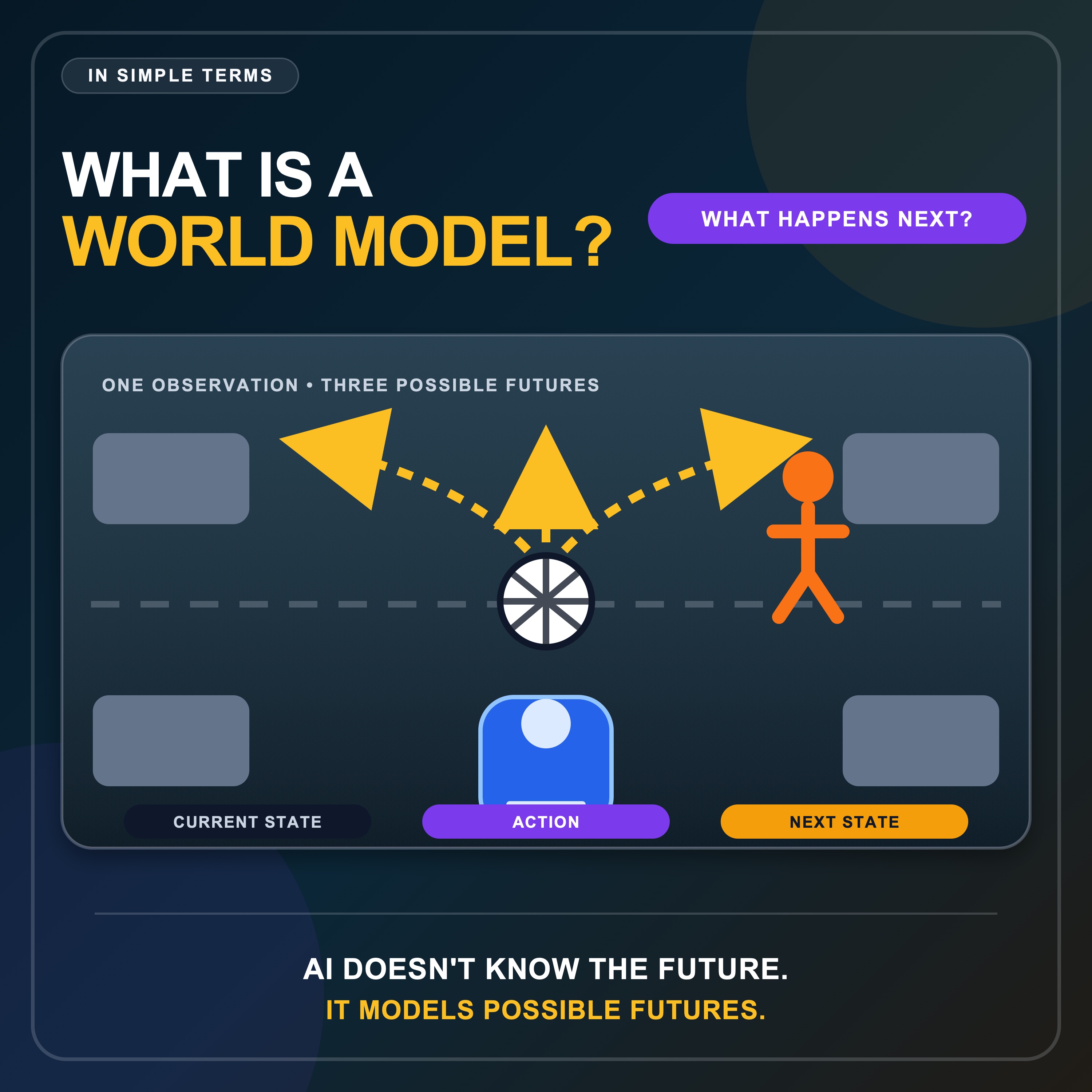
In simple terms, a world model helps an AI create an internal representation of a situation and predict how that situation could change.
The football is still moving.
The system needs to estimate its direction, speed and where it might stop. It also considers the parked cars, the road and the speed of your vehicle.
Together, these details represent the current state of the world.
Now the system asks:
"What could happen next?"
Perhaps the ball simply crosses the road.
Perhaps it stops in front of the car.
Or perhaps someone appears from behind one of those parked vehicles.
It is not predicting one guaranteed future. It is modelling several possible futures.
Computer vision helps the car recognize what is present.
A world model helps it estimate what could happen next.
But we are still missing one important piece.
The car must act. It could continue, slow down or brake.
Each action produces a different possible outcome.
Continuing may be safe, but it leaves less time to stop if a child appears. Slowing down creates more reaction time. Braking suddenly may reduce one danger while creating another for the vehicle behind it.
The system is not only modelling the outside world. It is estimating how its own actions could affect what happens next.
Engineers often describe this relationship using three simple ideas:
Current state. Action. Next state.
Where are we now?
What action can we take?
What is likely to happen after that action?
That relationship is at the heart of a world model.
But isn't this what a language model already does?
Not exactly.
If you describe this situation to a language model, it may explain that a child could follow the ball because it has learned that pattern from training data.
But a system operating in the physical world faces a changing situation. The ball is moving. The car is moving. The distance between them is shrinking.
It may need to act before danger becomes visible. Its prediction must remain connected to the environment in front of it.
That is why world models matter for robotics, autonomous vehicles, games and physical AI. A household robot, for example, must not only recognize a glass. It must estimate what happens if it tilts or drops it.
But here is the catch.
A world model does not know the future.
The football may belong to a child, may have escaped from a garden, or may have moved with the wind.
The system can be wrong. And the further it predicts, the more small errors can grow.
Physics may be modelled incorrectly, an object may behave inconsistently, or the system may encounter an unfamiliar situation.
So world models do not eliminate uncertainty. They help AI systems evaluate possible outcomes within that uncertainty.
The important moment was not when the car recognized the football. It was when the system connected it to a possible future—and considered an action before that future arrived.
So, what is a world model?
In simple terms:
A world model is an AI's internal representation of how an environment may change and what could happen when an action is taken.
Computer vision says:
"There is a football."
A world model asks:
"What could happen next—and what should I do about it?"
That is the shift: from recognizing what is present toward modelling how a situation may unfold.
But let me leave you with a question.
If your car sees only a football—but predicts that a child might follow—should it brake immediately?
How confident should an AI be before it acts?
Share your thoughts in the comments.
And if this episode helped you understand world models in simple terms, please like, share and subscribe to In Simple Terms with Satish.
I'll see you in the next episode.
Quick Check
-
What does a world model try to represent?
The episode frames a world model as a way to reason about state, action, prediction, and uncertainty.
-
What does action-conditioned prediction mean?
The model evaluates futures that depend on what the system might do next.
-
Why must a world model handle uncertainty?
World models can estimate likely futures, but the physical world can still surprise them.
-
How is this different from only recognizing an object?
Recognizing a ball is not enough; planning requires reasoning about what could happen next.
-
Why are world models useful for planning?
A planner can use predicted futures to choose an action, then update when reality changes.
Continue learning
Related Daily Tech Brief episodes
Explore another explanation from AI world models or continue through the latest technology systems.

What Is Multi-head Latent Attention—and How Does It Shrink AI's Memory?
Why does a long AI conversation consume more accelerator memory with every token? Follow the growth of the key-value cache, then see how Multi-head Latent Attention stores a compact latent representation, preserves position through decoupled RoPE, and trades a larger cache for additional projection work and specialized kernels.

What Is a Mixture of Experts Model—and Why Does Only Part of It Run?
How can an AI model contain many parameters without using all of them for every token? Walk through a dense layer and a sparse Mixture of Experts layer, then examine the router, top-k selection, active parameters, load balancing, and the infrastructure cost hidden behind sparse computation.
What Is an NPU—and Do You Really Need an AI PC?
We keep hearing the term “AI PC,” but how is it different from a regular computer? Compare the processors, workloads and software behind both categories—and learn when an NPU provides a real benefit, when cloud AI works just as well, and what to check before paying more.